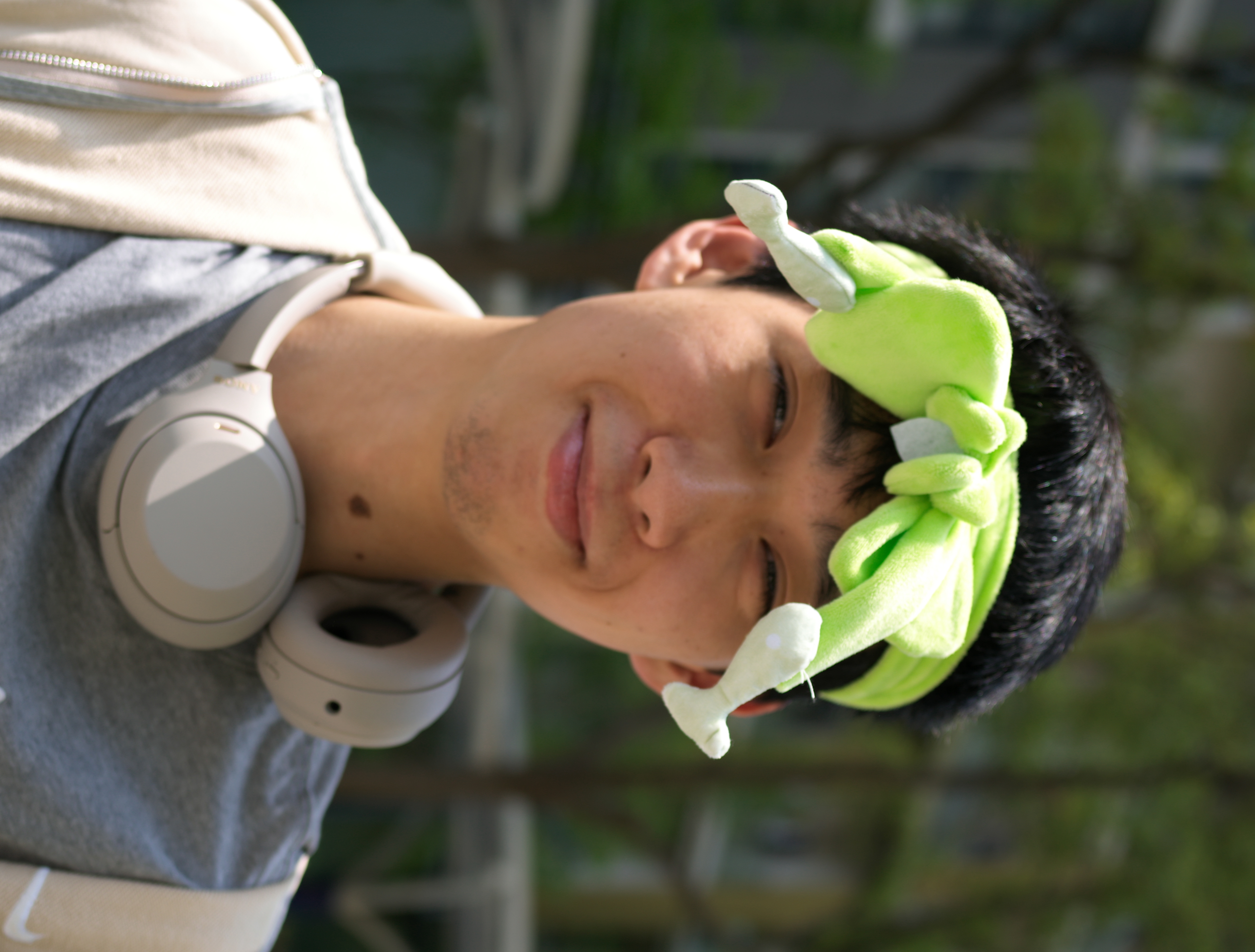
Wenye (Bear) Xiong 熊闻野
I am currently a Visiting Undergraduate Student at Harvard University (Sep. 2025 – May 2026) and an undergraduate student at ShanghaiTech University (B.E. in Computer Science and Technology, Minor in Life Sciences, expected Jun. 2027).
My research interests lie in Computer Vision, Embodied AI, and World Models, with a focus on compositional generative models, scene understanding, and spatial reasoning. Recently, I have been working on Compositional Scene Generation: learning disentangled representations from structured scene descriptions (e.g., scene graphs / object-relation specifications) to enable flexible control over diffusion-based generation and reasoning.
For more information, please see my Curriculum Vitae.
Research Interests
- Computer Vision
- Embodied AI & World Models
- Compositional Generative Models
- Scene Understanding & Spatial Reasoning
Education
- ShanghaiTech University — B.E. in Computer Science and Technology, Minor in Life Sciences (Sep. 2023 – Jun. 2027 expected)
- AI Honor Class
- Overall GPA: 3.82/4.0 (Rank 9/173 in CS major)
- General Evaluation Ranking: Rank 1/173 in CS major
- Relevant Coursework: Intro. to Information Science and Technology (A+), Intro. to Programming (A), Algorithms and Data Structures (A), Intro. to Machine Learning (A-), AI in Medical Imaging (A), Computational Science and Engineering (A+), Computer Architecture (A-) & Project (A), Protein Design (A+), Game Theory (A)
- Harvard University — Visiting Undergraduate Student (Sep. 2025 – May 2026)
- Overall GPA: 4.0/4.0
- Relevant Coursework: Signal Processing (MIT cross-registration) (A), Computer Vision (A), Planning and Learning Methods in AI (A), Hardware Architecture for Deep Learning (MIT cross-registration) (in progress), AI for Molecular Biology (in progress), High Performance Computing (in progress)
Awards & Honors
- Merit Student (Top 2% in school), ShanghaiTech University, 2023–2024
- Merit Student (Top 1 in CS major), ShanghaiTech University, 2024–2025
- AI Honor Class (Honors Degrees), ShanghaiTech University, 2024–2027 (expected)
- Gold Medal, International Genetically Engineered Machine Competition (iGEM), 2024
- First Place, Analytical Performance, SensUs Competition, 2025
- Outstanding Mentor Assistant, ShanghaiTech University, 2023
Experience
- Embodied Minds Lab, Harvard University & Kempner Institute — Visiting Undergraduate Research Assistant (Sep. 2025 – present)
Supervisors: Prof. Yilun Du & Dr. Ruojin Cai- Developed an inverse generative modeling framework for scene understanding on both synthetic and real-world datasets, training a relation-conditioned composable diffusion model that generates scenes from structured object-attribute and spatial-relation inputs.
- Focused on unsupervised object-relation discovery with Diffusion Models, enabling generative models to perform text-image attribution analysis on both synthesized and real-world images.
- Investigated the potential of improving compositional generation with unsupervised relation discovery in a training-free manner, achieving SOTA performance on the 2D spatial relation dataset VISOR.
- Perception, Learning and UnderStanding (PLUS) Lab, ShanghaiTech — Undergraduate Research Assistant (Jan. 2025 – Sep. 2025)
Supervisor: Prof. Xuming He- Investigated Compositional Scene Generation with scene-graph-based diffusion models.
- Focused on learning disentangled representations from scene graphs, enabling flexible control over the generation process.
- Explored Classifier-Free Guidance and training-free methods in image generation.
Selected Competitions
- PACIFY – iGEM 2024 [wiki] — Team Member (Dec. 2023 – Oct. 2024)
- Performed homology modeling to obtain protein structures and used AlphaFold 2 for structure prediction.
- Operated protein preparation and molecular dynamics simulation.
- Developed devices based on PID algorithm to address itchiness without harming the skin.
- Awarded Gold Medal.
- MakeSense, ShanghaiTech First SensUs Team — Co-Founder & Leader of Data Analysis Team (Aug. 2024 – Aug. 2025)
- Developed a wearable biosensor-based device to continuously monitor acute kidney injury (AKI) biomarkers.
- Invested in an enzyme-based creatinine sensor and QCM (Quartz Crystal Microbalance) platform.
- Set up a data analysis pipeline to process sensor data, achieving near-perfect accuracy in predicting creatinine concentration.
- First Place in Analytical Performance: “This team did an absolutely remarkable job with unprecedented results and near-perfect accuracy. This is a first in SensUs history and sets a new benchmark for other teams, especially as a first-time participating team.” — SensUs Committee.
Selected Projects
- De Novo Design of Odorant Binding Proteins for Breast Cancer Detection (Dec. 2024 – Jan. 2025)
Supervisor: Prof. Jiayi Dou- Designed three novel Odorant Binding Proteins (OBPs) to specifically recognize VOCs (hexanal, octanal, nonanal) that serve as biomarkers for breast cancer.
- Executed a complete de novo computational design pipeline, generating protein backbones with RFdiffusionAA and designing amino acid sequences using LigandMPNN.
- Validated designs using AutoDock, PyRosetta, and ESMFold, demonstrating significantly higher binding affinity and stability compared to natural counterparts.
- Neural Olfactory Sensing and Evaluation (NOSE) (May. 2025 – Jun. 2025)
Supervisor: Prof. Yujiao Shi- Fine-tuned MoLFormer, a large chemical language model, on the GS-LF olfactory dataset for specialized odor prediction tasks.
- Evaluated against the state-of-the-art OpenPOM on the Keller-2016 dataset, performing odor label classification and pleasantness rating prediction.
- Achieved state-of-the-art performance, with the fine-tuned model matching or surpassing OpenPOM on key metrics.
- Phase-Adaptive Quantization for AI Accelerators (Apr. 2026 – May 2026)
Supervisor: Prof. Joel Emer & Prof. Vivienne Sze (MIT)- Designed a phase-aware 4-bit quantization design-space exploration framework for LLM, VLM, and VLA inference workloads, comparing prefill and decode regimes across NVFP4-like, MXFP4-like, and custom rescale pipelines.
- Built an automated AccelForge experiment flow to generate workload/architecture YAMLs, run hardware energy/latency sweeps, extract per-einsum bottleneck breakdowns, and resume long-running Docker-based mappings.
- Implemented a Python quantization accuracy emulator using real model tensor snapshots to evaluate per-layer cosine similarity and combine accuracy with hardware cost for Pareto frontier analysis.
- Demonstrated that decode and prefill favor different quantization configurations, motivating phase-adaptive datapaths over a single fixed 4-bit format.
Technical Strengths
- Programming Languages: Matlab, Python, C & C++, RISC-V Assembly
- Framework & Toolchain: PyTorch, Git, Docker, Linux, Rosetta, CUDA, AccelForge, OpenMP, MPI
- Misc: LaTeX, Markdown, IELTS 7.5 (6.5), CET-6 (646)
Publications
No publications yet.
News
- 2025.09 Joined Embodied Minds Lab (Harvard University & Kempner Institute) as a Visiting Undergraduate Research Assistant.
- 2025.05 Admitted to the Visiting Undergraduate Student (VUS) program at Harvard University for the 2025–2026 academic year.
- 2025.01 Joined the PLUS Lab of SIST, ShanghaiTech University, advised by Prof. Xuming He.
- 2025 Our MakeSense team won First Place (Analytical Performance) at SensUs 2025.
- 2024.12 Awarded Merit Student of ShanghaiTech University (Top 2% in school) for 2023–2024.
- 2024.10 Our PACIFY project won the Gold Medal at iGEM 2024.
- 2023.10 Joined the AI Honor Class of SIST, ShanghaiTech University.
- 2024.06 Joined VRVC as an undergraduate research assistant.
- 2024.02 Joined ShanghaiTech iGEM Team.
- 2024.01 Awarded the 2023 Outstanding Mentor Assistant.